
Buying guide
Replacing Old Halogen Downlights with LED
If your ceilings are still dotted with halogen downlights, you're paying for it every time you flick the switch. A single 50W halogen uses roughly ten times the electricity of a modern LED, runs hot enough to scorch your fingers, and blows far more often. Switching to LED is one of the easiest home upgrades you can make — but there's a right way and a wrong way to do it.
This guide walks you through the retrofit decision: when a simple bulb swap will do, when it's better to replace the whole fitting, how to match cut-out sizes to the holes already in your ceiling, and what to watch for with transformers and dimmers. If you're new to downlights generally, our Ultimate Guide to LED Downlights covers the full picture.
First, identify what you've got: GU10 or MR16?
Before anything else, take one bulb out and look at the base. This single check determines your whole upgrade path.
- GU10 (mains voltage, 240V): two stumpy pins with flared feet. The bulb twists and locks into the holder. No transformer involved.
- MR16 (low voltage, 12V): two thin, straight pins that push into the holder. Somewhere above the ceiling there's a transformer converting mains power down to 12V.
Both bulbs look almost identical from the front — a 50mm reflector face — so the pins are the giveaway. If you're not sure, turn the circuit off at the switch before handling anything, and remember halogens stay hot for several minutes after they're turned off.
Option 1: just swap the bulb
GU10 halogen to GU10 LED: usually plug-and-play
Good news if you found GU10s: this is the easiest upgrade in lighting. GU10 LED bulbs are made to the same physical size and fitting as their halogen predecessors, so in most cases you simply twist the old bulb out and the new one in. No wiring, no transformer, no electrician needed for the swap itself.
A few things to get right when choosing replacements:
- Brightness: a 50W halogen puts out roughly 350–400 lumens, so look for an LED around that figure (typically 4.5–5.5W) for a like-for-like feel.
- Colour temperature: halogens glow at about 2700–3000K (warm white). If you loved that cosy tone, choose warm white LEDs — cool white can feel stark by comparison. Our colour temperature guide explains the options.
- Dimming: if the circuit is on a dimmer, you must buy dimmable LED bulbs — and possibly a new dimmer switch too (more on that below).
MR16 (12V) halogen: the transformer problem
MR16 fittings are where bulb swaps get complicated. That 12V transformer above your ceiling was designed to drive a 20–50W halogen load. Drop a 5W LED onto it and several things can go wrong:
- Minimum load issues: many older transformers need at least 20W of load to operate. A single LED falls well below that, causing flicker, strobing or the bulb refusing to light at all.
- Electronic transformer incompatibility: the high-frequency output of many electronic transformers simply doesn't play nicely with LED drivers.
- Hidden failure points: even if it works today, you've kept an ageing transformer in the circuit — one per fitting — each of which can fail and take your new LED with it.
Some MR16 LEDs will work with some transformers, but it's a gamble, and troubleshooting it fitting by fitting is nobody's idea of a weekend well spent. That's why the standard advice for MR16 systems is to convert to GU10: an electrician removes the transformer and fits a mains-voltage GU10 lamp holder (or, better still, a whole new fitting). Once the transformer is out of the picture, LED compatibility problems largely disappear. Because this involves mains wiring, confirm the work with a qualified electrician.
Option 2: replace the whole fitting (usually the best route)
If your downlights went in during the halogen era, they're likely 10–20 years old — and a straight bulb swap keeps all of that ageing hardware in your ceiling. Replacing the complete fitting with a modern fire-rated LED downlight costs a little more upfront but solves several problems at once:
- Fire rating. Every downlight hole is a breach in your ceiling's fire barrier. Many halogen-era fittings were never fire rated, which can let fire spread into the floor void far faster. Modern fire-rated downlights use intumescent seals that expand in heat to close the hole. Our guide to fire-rated downlights covers why this matters — and whether your ceilings need it is something to confirm with a qualified electrician.
- Sealed IP ratings. New fittings with IP65 ratings are sealed against moisture and steam, making them safe for bathrooms and kitchens, and they also block draughts and reduce dust ingress through the ceiling.
- Better beam control. Purpose-built LED downlights deliver cleaner, more even light than an LED bulb sitting in a reflector housing designed for halogen, with less glare and better colour rendering.
- No compatibility gambles. A complete GU10 fitting or integrated LED downlight is designed as one system — no transformer guesswork, no mismatched holders, no mystery flicker.
- Insulation safety. Many modern fittings can be covered by loft insulation (check the IC rating); old halogens generally couldn't, which is why so many lofts have insulation pulled back around hot fittings.
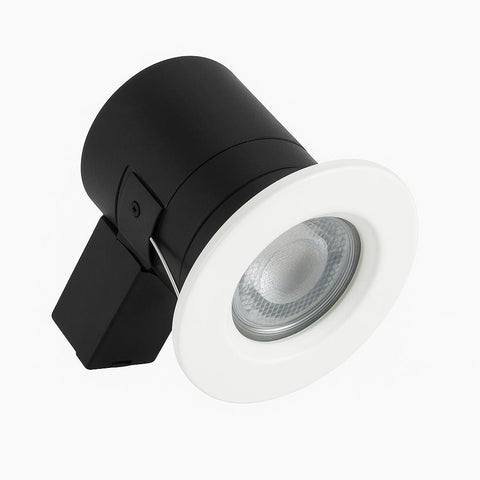
Fitting replacement involves disconnecting and reconnecting mains wiring, so have the installation carried out or confirmed by a qualified electrician. Browse our fire-rated GU10 downlights — available in fixed, adjustable and dimmable options — for like-for-like replacements that take standard GU10 LED bulbs.
Matching cut-out sizes to your existing holes
The biggest practical question when replacing fittings: will the new downlight fit the holes already in your ceiling? Get this right and installation is quick; get it wrong and you're filling and redecorating.
How to measure your cut-out
- Turn the circuit off, remove the bulb, and ease the old fitting down out of the ceiling (spring clips usually hold it in place — fold them up as you pull gently).
- Measure the diameter of the hole itself, not the visible bezel — the bezel is always wider than the hole it covers.
- Check a few holes around the room. They were often cut by hand and can vary by a few millimetres.
Most halogen-era downlights sit in a 70mm or 75mm cut-out, which is handy because these remain standard sizes today. Browse our 70mm cut-out downlights and 75mm cut-out downlights to match what's already there.
What if the sizes don't match?
You have two easy fixes:
- Choose a fitting with a wider bezel. Many downlights will happily cover a hole slightly smaller than their maximum cut-out, and the bezel hides a few millimetres of variation.
- Use a hole converter plate. These slim metal plates cover an oversized hole and provide a fresh, correctly sized aperture for the new fitting — far quicker than plastering. They're the standard solution when replacing old 80–90mm fittings with modern smaller downlights.
If you're rethinking the whole room rather than replacing hole-for-hole, our downlight spacing guide will help you plan quantities and positions properly — LEDs are brighter and more efficient, so you may not need as many as the halogen layout used.
What the switch saves you: running costs compared
This is where LED really earns its keep. The table below compares one 50W halogen with one typical 5W LED replacement, based on 4 hours' use per day and an example electricity rate of 27p per kWh (check your own bill for your actual rate — prices vary by tariff and change over time).
| 50W halogen | 5W LED | |
|---|---|---|
| Power per bulb | 50W | 5W |
| Energy per year (4 hrs/day) | 73 kWh | 7.3 kWh |
| Cost per bulb per year (at 27p/kWh, example rate) | ~£19.70 | ~£1.97 |
| Cost for 8 downlights per year | ~£157.70 | ~£15.80 |
| Typical bulb lifespan | 1,000–2,000 hours | 15,000–25,000 hours |
| Heat output | High — most energy lost as heat | Low — cool-running |
For a typical kitchen with eight downlights, that's a saving in the region of £140 a year at the example rate — before you count the halogen bulbs you're no longer replacing every year or two. Most LED upgrades pay for themselves within the first year or two of use, then keep saving for a decade or more.
Dimmer compatibility when switching to LED
If your halogens are on a dimmer, don't skip this section. Dimmer switches designed for halogen loads frequently misbehave with LED:
- Flicker or shimmer, especially at low levels;
- Buzzing from the switch or the bulbs;
- A limited dimming range — lights that cut out before reaching a proper low glow;
- Minimum load problems — old dimmers often need 40W+ of load, and a handful of LEDs may not reach it.
The fix is a matched pair: dimmable LED bulbs or fittings plus an LED-compatible dimmer (usually trailing-edge). Non-dimmable LEDs must never be used on a dimmer circuit, even with the dial turned to full. Replacing a dimmer switch is mains work, so confirm and carry it out with a qualified electrician. Many of our GU10 downlights are available with dimmable options if smooth mood lighting is on your wish list.
Signs your old fittings should be replaced entirely
Still tempted to just swap bulbs? Replace the whole fitting instead if you spot any of these:
- Scorching or discolouration on the ceiling around the fitting — a sign of years of halogen heat, and a reason to check the wiring above.
- Brittle, cracked or heat-damaged wiring or lamp holders behind the fitting.
- Loose or corroded spring clips that no longer grip the ceiling firmly.
- No fire rating — common in halogen-era fittings, and worth putting right whenever you're already up a ladder.
- MR16 fittings with ageing transformers — converting to mains GU10 removes the least reliable part of the system.
- Bathroom or kitchen fittings without an IP rating — modern sealed IP65 downlights are the safe choice around steam and splashes.
- Rust, pitting or a tired look — sometimes the honest reason is simply that a crisp new bezel lifts the whole room.
If any of these apply, a full swap to modern LED downlights is the safer, smarter route — and with fittings this affordable, there's little reason to nurse old hardware along.
Ready to make the switch?
Here's the short version: GU10 halogen? Swap the bulbs today. MR16? Convert to GU10 or replace the fittings. Fittings over a decade old? Replace them with fire-rated LED downlights and enjoy safer, cooler, dramatically cheaper lighting for years to come.
Browse our full range of fire-rated LED downlights and GU10 downlights to find your upgrade. Order by 3pm for same-day dispatch, enjoy free UK delivery on orders over £50, and shop with confidence thanks to our 30-day returns policy. And for anything electrical beyond a simple bulb swap, always confirm the work with a qualified electrician.
Frequently asked questions
Can I put an LED bulb in my halogen downlight?
If the fitting takes a mains-voltage GU10 bulb, yes — in most cases you can simply unclip the old halogen and twist in a GU10 LED. If it takes a 12V MR16 bulb with two push-in pins, it runs through a transformer that may not work properly with LED, so check compatibility or consider replacing the fitting.
How do I know if my downlight is GU10 or MR16?
Remove the bulb and look at the base. GU10 bulbs have two stumpy pins with flared feet that twist and lock into place. MR16 bulbs have two thin, straight pins that push in. GU10 runs on 240V mains; MR16 runs on 12V via a transformer.
Do I need an electrician to replace halogen downlights with LED?
Swapping a GU10 bulb is a DIY job. Replacing the fitting itself, removing transformers or changing dimmer switches involves mains wiring, so we'd always recommend you confirm the work with a qualified electrician.
Will LED bulbs work with my existing dimmer switch?
Not always. Dimmers designed for halogen loads often cause LED flicker, buzzing or a limited dimming range. You'll need dimmable LEDs plus an LED-compatible (trailing-edge) dimmer for smooth results — ask a qualified electrician to confirm and fit a replacement dimmer if needed.
What size hole do halogen downlights usually leave in the ceiling?
Most halogen-era downlights sit in a 70mm or 75mm cut-out, though sizes from 60mm to 90mm exist. Measure the hole itself (not the visible bezel) once the old fitting is out, and choose a new downlight with a matching cut-out — or use a converter plate to cover a mismatch.
Why is MR16 to GU10 conversion recommended?
Converting to GU10 removes the 12V transformer from the circuit entirely, which is the main source of LED compatibility problems — flicker, failure to light, and early transformer burnout. Mains-voltage GU10 LEDs are simpler, widely available and generally more reliable.
Is it worth replacing the whole fitting rather than just the bulb?
Usually, yes. A modern fire-rated LED downlight restores your ceiling's fire barrier, seals against moisture and draughts, gives better beam control and avoids transformer or dimmer gambles. If your fittings are 10–15+ years old, a full replacement is the better long-term investment.
How much money will I save switching halogen downlights to LED?
A 50W halogen replaced by a roughly 5W LED uses about 90% less electricity. Across a typical kitchen with six or eight downlights running a few hours a day, that adds up to a meaningful saving every year — and LED bulbs last many times longer, so you replace them far less often too.
Shop this guide

Ready to choose?
Browse the range — order by 3pm for same-day dispatch.
Shop the rangeSame-day dispatch before 3pm · Free UK delivery over £50 · 30-day returns