
Buying guide
Downlight Colour Temperature Guide: Warm White vs Cool White
Choosing downlights and stuck between warm white and cool white? You're not alone — colour temperature is the single decision people most often get wrong, and it's the one that changes how a room feels more than anything else. The good news: once you understand what the Kelvin numbers mean, the right choice for each room is usually obvious. And if you genuinely can't decide, there's now a downlight that lets you change your mind after installation.
This guide is part of our Ultimate Guide to LED Downlights series. Here we'll cover what colour temperature actually is, which Kelvin value suits each room, how CCT-switchable and 4CCT downlights work, and the mistakes to avoid.
What does Kelvin actually mean?
Colour temperature describes the tone of white light, measured in Kelvin (K). It has nothing to do with how hot the fitting gets, and nothing to do with brightness — that's lumens. Kelvin simply tells you where the light sits on a scale from warm and golden to cool and blue-white.
- Lower Kelvin (2700K–3000K) — warmer, softer, more yellow. Think candlelight, sunsets and old-fashioned bulbs.
- Middle Kelvin (4000K) — neutral to cool white. Crisp and clean without being harsh.
- Higher Kelvin (6000K–6500K) — daylight white. Bright, blue-tinged and energising.
A useful mental shortcut: low numbers relax you, high numbers wake you up.
The four colour temperatures you'll actually meet
2700K — extra warm white
This is the closest match to the old incandescent and halogen bulbs many of us grew up with. It's a golden, honeyed light that makes wood tones glow, softens skin and instantly makes a room feel like evening. If you love a cosy, hotel-bar atmosphere — or you're replacing halogen downlights and want the room to feel exactly the same — 2700K is your number.
3000K — warm white
The modern default for living spaces. Still unmistakably warm and welcoming, but slightly whiter and fresher than 2700K, so colours look a touch truer and the room feels a little brighter at the same lumen output. If you're torn between cosy and practical, 3000K is the safest all-rounder for most of the home.
4000K — cool white
Crisp, clean and businesslike. 4000K is the light of modern kitchens, smart bathrooms and offices. It makes white worktops and tiles look genuinely white rather than cream, sharpens detail for close work, and gives a space an alert, daytime feel. Wonderful where you're chopping, cleaning or concentrating — less wonderful where you're trying to unwind.
6500K — daylight
A bright, blue-white light that mimics overcast midday sky. It's excellent for garages, workshops, utility rooms and commercial settings where visibility trumps atmosphere. In a living room it will feel like a dentist's waiting room, so treat 6500K as a specialist tool rather than an everyday choice for the home.
Room-by-room recommendations
Every home is different, but these recommendations hold true for the vast majority of UK houses.
| Room | Recommended Kelvin | Why |
|---|---|---|
| Living room | 2700K–3000K | Warm light suits relaxing, watching TV and entertaining in the evening. |
| Bedroom | 2700K–3000K | Warm tones help you wind down; cool light can disrupt sleep routines. |
| Kitchen | 4000K | Crisp light for food prep, true colours and clean-looking surfaces. |
| Open-plan kitchen-diner | 3000K–4000K | Compromise on 3000K throughout, or zone it — cooler over worktops, warmer over dining. |
| Bathroom | 3000K–4000K | 4000K for a fresh, spa-clean feel; 3000K if you prefer relaxing soaks. |
| Hallway and landing | 3000K | A neutral bridge between warm and cool rooms. |
| Home office | 4000K | Cooler light supports focus and reduces eye strain on screens. |
| Utility room | 4000K–6500K | Visibility matters more than atmosphere. |
| Garage or workshop | 6500K | Maximum clarity for detailed tasks. |
For kitchens specifically — layout, brightness over worktops and more — see our dedicated Kitchen Downlights Guide, and for wet areas our Bathroom Downlights Guide covers IP ratings and zones alongside colour choice.
Can't decide? CCT-switchable and 4CCT downlights
Here's the option that has quietly solved this whole dilemma: CCT-switchable downlights. CCT stands for "correlated colour temperature", and a switchable downlight contains LEDs capable of producing several different colour temperatures. A small switch on the back or side of the fitting lets you choose which one it uses.
A typical 3CCT downlight offers 3000K, 4000K and 6000K. A 4CCT downlight adds a fourth setting — usually an extra-warm 2700K — so one product covers everything from cosy lounge to bright utility room. Some models even offer five or six settings.
The key point is that the switch is on the fitting itself, not the wall. You (or your electrician) set it during installation, and if you live with it for a week and decide the kitchen feels too warm, you flick the switch to a cooler setting. No new downlights, no rewiring, no returns.
CCT-switchable downlights are ideal for:
- Undecided buyers — you don't have to commit until the lights are in and you can see the effect in your own room.
- Landlords and developers — buy one product for every room in every property, and set each fitting to suit the space. It simplifies ordering and spares.
- Whole-house projects — one box of identical fittings covers the lounge, kitchen, bathroom and hallway.
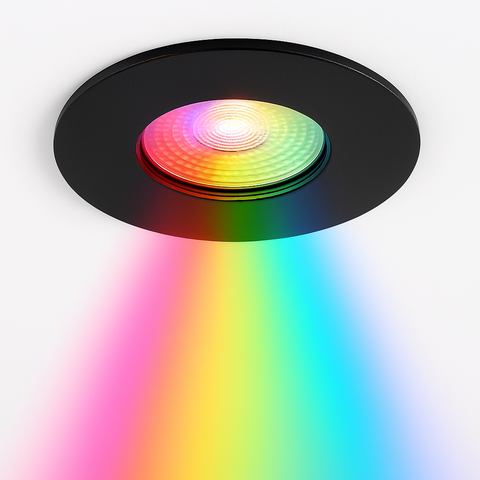
Most of the fittings in our LED downlights collection now offer CCT switching as standard. If you want to go further and change colour temperature from your phone or by voice — or add colour-changing scenes — take a look at our smart RGB Wi-Fi downlights, which let you adjust white tones and colours on demand rather than at the switch.
Mixing colour temperatures in one home
You don't need one colour temperature for the whole house — in fact, most well-lit homes deliberately mix them. A few rules of thumb keep it looking intentional rather than accidental:
- One temperature per room. Mixing 3000K and 4000K downlights in the same ceiling is the fastest way to make a room look like a mistake. Keep every downlight in a room identical.
- Warm where you relax, cool where you work. Living rooms, bedrooms and snugs get 2700K–3000K; kitchens, bathrooms, offices and utility rooms get 4000K.
- Step gradually between adjacent spaces. Moving from a 3000K hallway into a 4000K kitchen feels natural. Jumping from 2700K straight into 6500K feels jarring. Use 3000K in hallways and landings as a neutral bridge.
- Zone open-plan spaces by activity. In a kitchen-diner, it's perfectly acceptable to run 4000K over the worktops and 3000K over the dining table — the change in temperature actually helps define the two areas. Just keep the boundary tidy rather than alternating fittings.
- Match table and floor lamps to your downlights. A 2700K lamp under 4000K downlights will look orange; the same lamp under 3000K downlights looks lovely.
If you're also working out how many fittings each room needs, our downlight spacing guide pairs neatly with this one — get the temperature and the layout right and the room essentially lights itself.
A quick word on CRI
Colour temperature tells you the tone of the light; CRI (Colour Rendering Index) tells you how accurately that light shows colours, on a scale up to 100. A low-CRI light can make food look grey and skin look washed out even at a pleasant colour temperature. For homes, look for CRI 80 or above as a minimum, and CRI 90+ where colour really matters — kitchens, dressing areas and anywhere you'll be checking whether the navy sock matches the black one. Two downlights can share the same Kelvin rating and still look noticeably different if their CRI differs, so it's worth checking both numbers.
Common mistakes to avoid
- Cool white in the living room. The number-one regret. 4000K makes an evening space feel like an office; 6500K makes it feel like an operating theatre. Stick to 2700K–3000K where you relax.
- Mixing temperatures in one ceiling. Usually the result of replacing one failed fitting with a different spec. Buying CCT-switchable downlights avoids this forever — any replacement can be set to match.
- Choosing daylight because it sounds natural. "Daylight" 6500K is modelled on overcast midday sky, not golden afternoon sun. In most homes it reads as harsh and blue.
- Confusing Kelvin with brightness. A dim room needs more lumens, not a cooler colour. Cool light can feel brighter, but if the room is genuinely underlit, changing temperature won't fix it.
- Ignoring the rest of the room. Cream walls and oak floors flatter warm light; grey, white and marble schemes suit 3000K–4000K. Test before committing to a whole ceiling — or fit switchable downlights and test afterwards.
Ready to choose?
To recap: 2700K–3000K for relaxing rooms, 4000K for working rooms, 6500K only where clarity is everything — and if in doubt, CCT-switchable downlights let you decide once the lights are in. Browse our full LED downlights collection, or if your project is kitchen-focused, start with our kitchen downlights collection.
Order by 3pm and we'll dispatch the same day, delivery is free on UK orders over £50, and everything is covered by our 30-day returns policy — so if a colour temperature doesn't suit your room, you're never stuck with it.
Frequently asked questions
What colour temperature is best for a kitchen?
Most UK kitchens look best in 4000K cool white. It's crisp and clean, makes worktops easier to work on and helps food colours look true. If your kitchen opens onto a living or dining space, 3000K warm white is a good compromise — or choose CCT-switchable downlights and decide once they're in.
What is the difference between warm white and cool white?
Warm white (2700K–3000K) has a soft, yellowish tone similar to a traditional halogen or incandescent bulb — cosy and relaxing. Cool white (4000K) is a whiter, crisper light closer to daylight, better suited to task areas like kitchens, bathrooms and home offices.
What is a CCT-switchable downlight?
A CCT-switchable downlight lets you change the colour temperature using a small switch on the fitting itself, usually before or after installation. One product typically covers 3000K, 4000K and 6000K (or more), so you can try a setting, live with it for a few days and change it if it doesn't feel right — no rewiring needed.
What does 4CCT mean?
4CCT means the downlight offers four selectable colour temperatures — typically something like 2700K, 3000K, 4000K and 6000K — chosen via a switch on the fitting. It's the same idea as 3CCT switchable, just with an extra warm option, which is handy for living rooms and bedrooms.
Is 3000K or 4000K better for a living room?
For living rooms, 2700K–3000K warm white is almost always the better choice. It creates a relaxed, welcoming atmosphere in the evenings. 4000K can make a living room feel stark and office-like, which is one of the most common lighting regrets we hear about.
Can I mix different colour temperatures in one house?
Yes — most homes do. The rule is one colour temperature per room, warm in relaxing spaces and cooler in working spaces. Try to step gradually between adjacent open areas (for example 3000K in the dining area next to 4000K in the kitchen) rather than jumping between extremes.
What colour temperature is daylight?
Natural daylight varies through the day, but 6000K–6500K is generally described as "daylight" white. It has a bright, blue-tinged quality that suits garages, workshops and some commercial spaces, but it's usually too harsh for living areas at home.
Does colour temperature affect brightness?
No — brightness is measured in lumens, and colour temperature in Kelvin. A 2700K and a 6500K downlight with the same lumen output are equally bright. Cooler light can feel brighter because of its crispness, but the actual light output is the same.
Shop this guide
Ready to choose?
Browse the range — order by 3pm for same-day dispatch.
Shop the rangeSame-day dispatch before 3pm · Free UK delivery over £50 · 30-day returns