
Buying guide
Bathroom Downlights: The Complete Guide
The bathroom is where lighting has to work hardest. At 7am you want bright, honest light for shaving or make-up. At 9pm you want the opposite — something soft enough to soak in the bath by. Add steam, splashes and safety rules into the mix, and it's no wonder so many bathrooms end up with one gloomy centre light and a resigned shrug.
The good news: LED downlights solve almost all of this. They sit flush to the ceiling, shrug off moisture when properly rated, and — planned well — give you flattering, even light that a single pendant never could. This guide walks you through designing bathroom lighting with downlights: how many you need, which colour temperature to pick, what to do about steam, and the mistakes we see most often. If you're brand new to downlights generally, our ultimate guide to LED downlights covers the fundamentals.
First things first: zones and IP ratings in 60 seconds
Before any design talk, one bit of housekeeping. Bathrooms are divided into safety zones based on how close a fitting sits to water:
- Zone 0 — inside the bath or shower tray itself. Downlights don't go here.
- Zone 1 — directly above the bath or shower, up to 2.25m. You'll want IP65 here.
- Zone 2 — the area 60cm around the bath or basin. IP44 minimum; many people fit IP65 anyway.
- Outside the zones — the rest of the room, where standard fittings are technically permitted.
That's the headline version. For the full zone diagrams, what IP numbers actually mean and the edge cases (shower rooms, low ceilings, ventilation), read our dedicated bathroom IP ratings and zones guide — it's the regulations deep-dive this design guide deliberately doesn't repeat. And whatever you plan, confirm the final layout with a qualified electrician; bathroom electrics are notifiable work in the UK.
The simplest hedge, and the one we usually suggest: fit IP65-rated downlights throughout the bathroom. Everything in our bathroom downlights collection is IP rated, so you're choosing on looks and light rather than worrying about zone maps.
Designing the light: two layers beat one bulb
The classic bathroom mistake is a single centre light. It casts your own shadow over the basin, leaves corners murky, and puts harsh light directly above your head — which means dark hollows under your eyes and chin in the mirror. Not the look anyone's after first thing.
Think in two layers instead:
Layer 1: general light across the ceiling
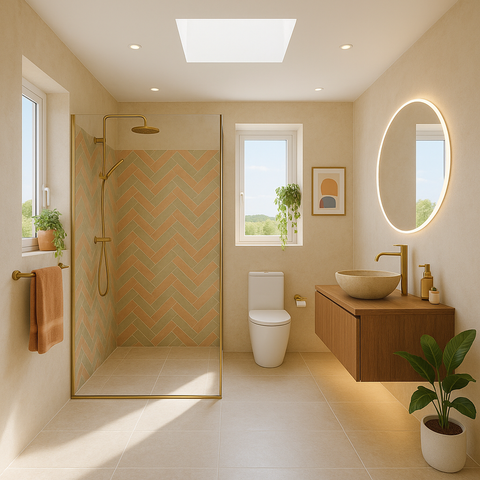
A grid of downlights spaced evenly across the room gives you shadow-free, edge-to-edge light. This is the workhorse layer — it makes the room feel bigger, keeps corners bright, and means the shower isn't a dim cave at one end.
Layer 2: task light at the mirror
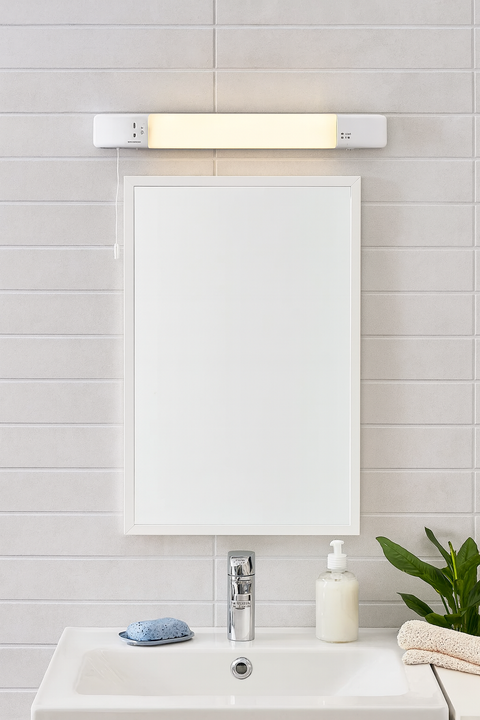
Faces need light from the front, not just from above. The ideal is light either side of the mirror or a lit mirror itself — but downlights can help here too. Position a downlight around 30–40cm out from the wall above the basin, so light washes down your face rather than the top of your head. Pairing ceiling downlights with wall or mirror lighting from our LED bathroom lights collection gives you the best of both.
How many downlights does a bathroom need?
Bathrooms are usually small, so this is easier than it sounds. The working rules: space downlights roughly 1m to 1.2m apart, keep them about 60cm from walls (a little further out over the basin, as above), and aim for slightly brighter than a bedroom — you're doing detail work in here.
| Bathroom size | Typical layout | Downlights |
|---|---|---|
| Small ensuite (1.5m x 1.5m) | Compact WC + shower | 2–3 |
| Standard bathroom (2m x 2m) | Bath or shower + basin | 3–4 |
| Family bathroom (2m x 2.5m) | Bath, basin, WC | 4–6 |
| Large bathroom (3m x 3m+) | Separate bath and shower | 6–8 |
These are honest starting points, not gospel — an L-shaped room or a dark colour scheme shifts the numbers. For an answer tailored to your exact dimensions, use our free downlight spacing calculator, and if you want the full theory behind the numbers, our spacing guide works through it room by room.
Colour temperature: flattering or crisp?
Colour temperature — measured in kelvins (K) — decides whether your bathroom feels like a spa or a dentist's surgery.
- 3000K warm white is the crowd-pleaser. It's gently flattering on skin tones, makes white tiles feel warm rather than clinical, and suits evening baths perfectly.
- 4000K cool white is crisper and more accurate — genuinely useful for shaving, make-up and cleaning. It suits modern grey and white bathrooms, but can feel stark at night.
- 2700K extra warm works in traditional or cosy schemes, though it can make a small windowless bathroom feel a touch dim.
Can't decide? You don't have to. CCT-switchable downlights let you flick between colour temperatures — usually via a switch on the fitting — after installation. Set the whole bathroom warm, or run it cool and see how it feels for a week. It's the single easiest way to de-risk the decision, and it's why switchable fittings have become our default recommendation for bathrooms. There's a fuller explanation in our colour temperature guide.
Steam, condensation and everyday life
A hot shower turns a bathroom into a temporary steam room, and that moisture has to go somewhere. A few practicalities worth knowing:
- IP-rated downlights handle steam fine. The sealed front face keeps humid air out of the electrics, which is exactly what those ratings are for. Everyday condensation on the bezel simply evaporates.
- Extraction matters more than people think. A working extractor fan clears steam quickly, which protects your ceiling, your grout and your fittings alike. If your mirror stays fogged for ten minutes after a shower, the fan needs attention before the lighting does.
- Sealed fittings also block draughts. A well-sealed IP-rated downlight stops warm, moist air escaping into the loft or ceiling void, where it can condense and cause damp problems you won't see until much later.
- Wipe-down is all the maintenance you need. An occasional pass with a dry or barely damp cloth keeps bezels bright. No bulb changes either — quality LEDs last for years of daily showers.
Fire rating still applies in the bathroom
It's easy to focus so hard on IP ratings that fire ratings get forgotten — but cutting holes in a ceiling weakens its fire resistance wherever that ceiling is. If there's a room (or loft) above your bathroom, fire-rated downlights restore the ceiling's ability to hold back fire, typically for 30, 60 or 90 minutes depending on the construction.
The practical takeaway: for bathrooms you generally want fittings that are both fire rated and IP rated. Happily, that's not a compromise — most quality bathroom downlights carry both, so it's simply a box to check on the spec rather than a trade-off. Your electrician can confirm the fire rating your ceiling construction requires.
Finishes: what survives a steamy room looking good?
Bathroom fittings get splashed, steamed and wiped more than any others in the house, so finish choice is partly about looks and partly about upkeep:
- Chrome is the bathroom classic for a reason — it matches taps and shower fittings, and water marks wipe off a polished surface easily. Browse our chrome downlights.
- White disappears into a white ceiling, which is exactly what most bathrooms want — the light shows, the fitting doesn't. Water marks are near-invisible on white. See our white downlights.
- Brushed and satin finishes hide fingerprints and light water spotting better than polished ones, and suit brushed-nickel tapware.
- Matt black looks striking in a monochrome scheme but shows limescale spotting in hard-water areas — be ready to wipe it down a little more often.
Dimming: the evening-bath upgrade
If you do one thing beyond the basics, make it dimming. The same downlights that give you bright, functional morning light can drop to a low, candle-adjacent glow for an evening soak — no second circuit, no extra fittings, just a dimmable downlight and a compatible LED dimmer switch.
Two things to get right. First, make sure both the downlight and the dimmer are LED-compatible with each other — mismatched pairs cause flicker or a limited dimming range. Second, the dimmer switch itself lives outside the bathroom door (or must be a suitable bathroom-rated control); your electrician will position it correctly as part of the job.
Small bathrooms and ensuites
Compact rooms deserve special mention because standard-size downlights can overwhelm a tiny ceiling. Mini downlights — smaller cut-out, neater face — light an ensuite evenly with two or three fittings while keeping the ceiling calm and uncluttered. They're also handy where joists or pipework leave little room for a full-size cut-out. Our mini downlights collection has compact IP-rated options made for exactly this job.
A couple of small-room tricks: keep the colour temperature consistent with the adjoining bedroom so the ensuite feels like part of the same space, and don't skip the mirror-area light just because the room is small — it's the light you'll use most.
Common bathroom lighting mistakes
- One light in the middle of the ceiling. Shadows on faces, gloomy corners, dim shower. The whole reason this guide exists.
- Ignoring the mirror. Overhead light alone is unflattering. Bring light forward over (or beside) the basin.
- Guessing IP ratings. "It's probably fine" is not a zoning strategy. Check the zones — or fit IP65 throughout and stop worrying.
- Forgetting fire rating. IP protects against water; fire rating protects the ceiling. Bathrooms need you to think about both.
- Going too cool. 6000K "daylight" downlights make a bathroom feel like an operating theatre. Stick to 3000–4000K, or fit CCT-switchable and choose later.
- Skipping the dimmer. It's a modest addition at install time and the upgrade people say they'd never go back on.
- Not using a spacing plan. Downlights bunched around the ceiling rose position, or pushed into corners, light the room unevenly. Two minutes with the calculator fixes it.
Ready to plan your bathroom?
Start with the layout — run your room dimensions through the spacing calculator — then choose IP-rated, fire-rated, dimmable fittings in the finish that suits your scheme. Our bathroom downlights collection gathers everything that's safe for the job, and the wider LED bathroom lights range covers the mirror and wall lighting that completes the picture.
Order by 3pm and we'll dispatch the same day, delivery is free on UK orders over £50, and our 30-day returns policy means you can check a fitting against your ceiling before committing to the full set. And once your plan is drawn up, hand it to a qualified electrician to confirm the zones and do the installation — that final sign-off is what makes a beautifully lit bathroom a safe one too.
Frequently asked questions
Do bathroom downlights need to be IP65?
Not always, but it's the simplest safe choice. IP65 is required in Zone 1 (directly over the bath or inside the shower) and strongly recommended in Zone 2. Outside the zones a standard downlight is technically allowed, but many people fit IP65 throughout for peace of mind and easier planning. See our IP ratings and zones guide for the detail, and confirm your layout with a qualified electrician.
How many downlights do I need in a bathroom?
As a rule of thumb, a typical family bathroom (around 2m x 2.5m) works well with 4 downlights, larger bathrooms with 6, and a small ensuite with 2–3. Space them roughly 1m to 1.2m apart and about 60cm from the walls. Our spacing calculator gives you a tailored answer for your exact room size.
What colour temperature is best for bathroom downlights?
3000K warm white is the most popular choice — it's flattering on skin and relaxing for evening baths. 4000K cool white looks crisper and can help with shaving and make-up. If you can't decide, CCT-switchable downlights let you change between settings after installation.
Do bathroom downlights need to be fire rated?
If your downlights cut into a ceiling with a room above, fire-rated downlights are needed to restore the ceiling's fire resistance — that applies in bathrooms just as it does anywhere else in the house. Most quality bathroom downlights are both fire rated and IP rated, so you don't have to choose between the two.
Can bathroom downlights be dimmed?
Yes, as long as you fit dimmable downlights and pair them with a compatible LED dimmer switch. The dimmer switch itself must be located outside the bathroom (or be a suitable bathroom-rated control) — your electrician will position it correctly. Dimming is one of the best upgrades for a bathroom, taking you from bright morning light to a soft soak-in-the-bath glow.
Will steam and condensation damage LED downlights?
Not if you choose sensibly. IP-rated bathroom downlights are sealed against moisture and humidity, so everyday steam is no problem. Good extraction helps too — a working extractor fan reduces the condensation that sits on ceilings and fittings after a hot shower.
Are mini downlights any good for small bathrooms and ensuites?
They're ideal. Mini downlights have a smaller cut-out and a neater face, so two or three of them light a compact ensuite evenly without visually crowding the ceiling. Browse our mini downlights collection for compact IP-rated options.
Who should install my bathroom downlights?
Bathroom electrical work is notifiable in the UK, so it should be carried out or certified by a qualified electrician. They'll confirm your zones, check IP ratings and earth bonding, and make sure everything is signed off correctly. Treat everything in this guide as planning help, not a substitute for their advice.
Shop this guide
Ready to choose?
Browse the range — order by 3pm for same-day dispatch.
Shop the rangeSame-day dispatch before 3pm · Free UK delivery over £50 · 30-day returns